
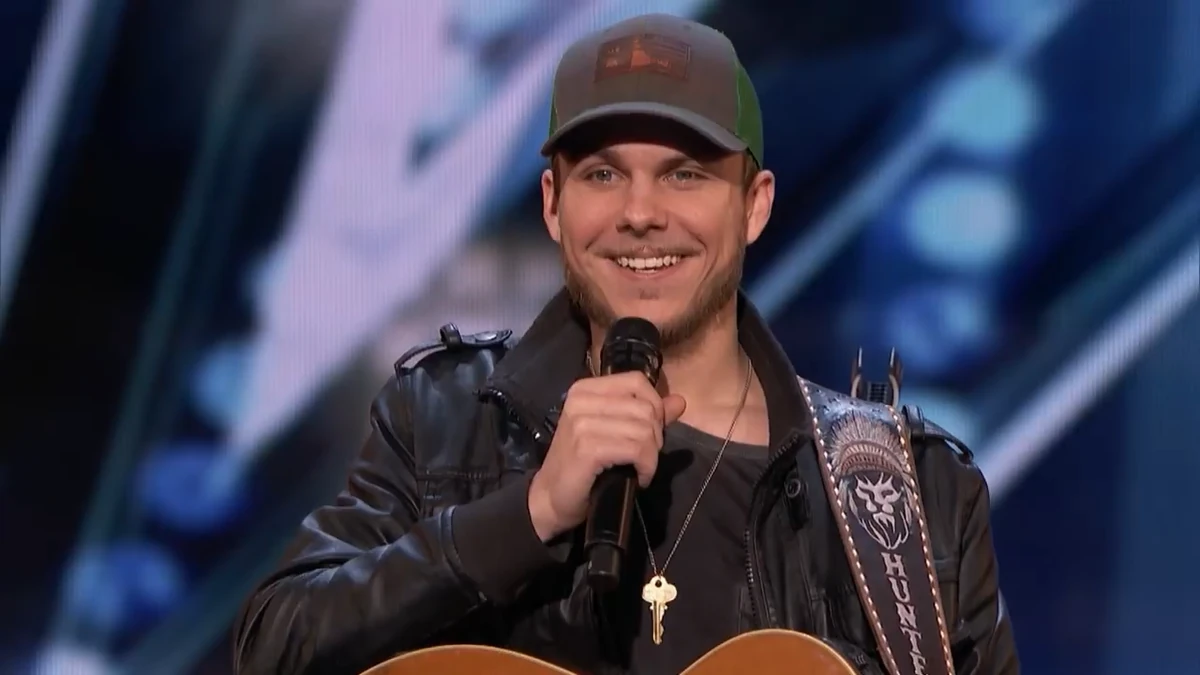
Hunter Price, a 25-year-old singer from Georgia, stepped onto the America’s Got Talent (AGT) stage with a mix of anticipation and nerves. As he took a deep breath and cleared his throat, he was preparing to perform the classic hit “Everything I Do” by Bryan Adams, a song that resonates with heartfelt emotion and nostalgia. However, as he began to sing, it quickly became evident that something was off. The performance lacked the spark he had hoped to convey, and within moments, the atmosphere turned tense.
Judge Simon Cowell, known for his direct and often blunt feedback, wasted no time in expressing his disappointment. He abruptly halted the music, the abruptness of his action sending a wave of shock through the auditorium. “This is very generic,” he said coolly, “It sounds like a song I’ve heard a million times in karaoke competitions.” The words stung, cutting through Hunter’s confidence like a knife. Standing there, he faced an unexpected crossroads—a high-stakes, mid-audition pivot that could unravel the very foundation of his dreams or give him a chance for redemption.
In that moment, Simon offered Hunter a lifeline, asking if he had an original song he could perform instead. The offer reignited a flicker of hope in Hunter’s heart. He had poured so much of himself into writing music inspired by artists like Taylor Swift, and now he could finally share something that was genuinely his. With a newfound determination flashing across his face, he revealed the title of his original song, “Left Behind.” As he began to play, the atmosphere in the auditorium shifted dramatically.
The moment Hunter started singing, it was as though a veil had been lifted. The song contrasted sharply with his previous attempt, revealing a depth and authenticity that had been completely hidden before. “Left Behind” had a beautiful melody paired with heartfelt lyrics that spoke of a painful past filled with longing and reflection. In the intensity of the performance, he poured out his emotions, drawing the audience into his world.
To elevate the power of the moment, Hunter shared a poignant part of his story, explaining that he had been living independently since the age of 18. He candidly opened up about the struggles he had faced, including times when he “hadn’t had enough money to eat.” Those words resonated, lending significant emotional weight to his songwriting. As his voice soared through the auditorium, the judges, along with the audience, began to feel the raw honesty in his performance, recognizing that this was not just a song—it was a piece of his life laid bare for all to see.
The contrast between the two performances did not go unnoticed by the judges. They acknowledged that they had essentially witnessed “two different auditions.” Sofía Vergara, who had previously been unsure about Hunter’s talent, admitted that had she judged him solely on his first song, she would have handed him a “no.” But now, captured by the depth of his lyrics and the sincerity of his delivery, she was the first to raise her hand with a solid “yes.” It was a remarkable turnaround and a testament to the power of vulnerability in artistry.
Howie Mandel, however, remained somewhat skeptical. Though he appreciated the emotional depth Hunter had displayed, he advised him to “open up” and be more genuine, sensing that there was still more for him to uncover as an artist. His words carried weight, suggesting that authenticity and a deeper emotional connection could elevate Hunter’s performances even further.
Then it was Simon’s turn to offer his insight. After reflecting on both performances, he stated that Hunter had the potential to be a better songwriter than he realized. Simon encouraged him to focus less on trying too hard to please the audience and instead to stay true to his own voice and experience. This advice was valuable; it reminded Hunter that his individuality was his strength.
As the judges deliberated, it was clear that Hunter’s raw, honest talent displayed in “Left Behind” had left a lasting impression. Ultimately, he earned a total of three “yeses,” a triumphant validation of his artistry and perseverance. The relief washed over him, mingling with pride and anticipation for what lay ahead.
With the support of the judges, Hunter felt that he had been granted a vital second chance, an opportunity to prove himself as an authentic artist. As he left the stage, an air of determination surrounded him. The experience taught him the significance of vulnerability in music and the importance of sharing his authentic self. He walked off with dreams reignited, ready to embrace whatever came next in his musical journey.
In those moments of triumph and doubt, Hunter Price reminded everyone that sometimes, all it takes is one chance to transform a narrative and reveal the true voice within.